The method that multiplies an e-commerce catalog's semantic coverage by 5, without duplicating a single tag.
When optimizing the title and meta description tags of an e-commerce catalog, the reflex is to set up a template. "Professional hair styling chair: free shipping", duplicated across all product pages, just swapping the product name. Quick, clean, scalable.
But it generates a catalog where every page says the exact same thing, except the product name. To Google, that's thin and repetitive content. Worse: you miss the full spectrum of queries your customers actually type. Nobody searches just for "professional hair styling chair". Real queries include "premium hair styling chair", "high-end hair styling chair", "pro grade salon chair", and dozens of variants your uniform tags ignore.
"On an audit I ran in early 2026, 76% of title+meta combinations generated by the CMS's native plugin contained the word 'professional' at least twice. Unacceptable from both an SEO and editorial standpoint."
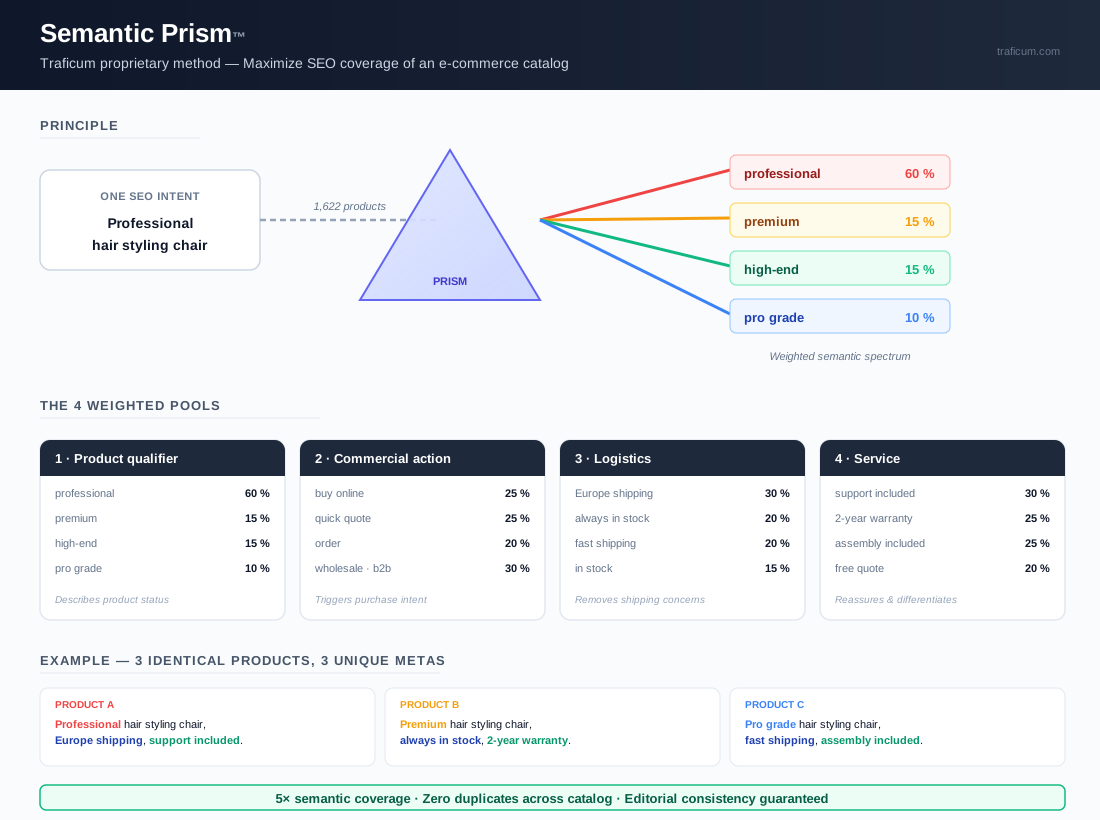
A prism decomposes white light into a colored spectrum. The Semantic Prism applies the same principle to a single SEO intent: it decomposes it into multiple equivalent wordings, calibrated against actual Google search volumes.
Each pool contains 4 to 5 interchangeable variants. Each variant has a weight based on its actual search volume on Google. Weighted rotation applies across the entire catalog.
Describes product status
Triggers purchase intent
Removes shipping concerns
Reassures & differentiates
Title ≤ 60 characters, meta description ≤ 160 characters. Smart truncation: optional complements are dropped first, never a brutal cut.
Before publishing, each title is hashed. On collision → forced rotation of a complement. Zero duplicates across the catalog, even on near-identical products.
If the product carries a high-volume attribute (hydraulic, electric, massage, foldable, heated, double), the attribute is auto-injected into the tag to capture long-tail demand.
QA regex: maximum 2 occurrences of "pro / professional" per title+meta couple. Above that, forced rotation until compliance. End of keyword stuffing.
Semantic pools duplicated per language with weights recalibrated on the local market. No machine translation from source: search intents vary across countries.
Final deliverable is a UTF-8 BOM CSV importable into Odoo, Magento, PrestaShop, Shopify or WooCommerce. No dependency on a CMS-native templating plugin, often too rigid.
A French supplier of professional hair, beauty and barber shop furniture. Odoo catalog of 1,622 products, tags generated by the CMS's native plugin: uniform, redundant, with "professional" multiplied by 3 or 4 in a single meta.
Semantic Prism method applied in six steps: Sitebulb crawl of the sitemap, product attribute extraction, Python-scripted generation with weighted rotation, automated QA, ready-to-import CSV delivery. Everything integrated on the Odoo side without touching the native templating plugin.
Semantic coverage
vs. uniform tags
Duplicates across
1,622 product pages
Tags compliant with
Google constraints
The engine automatically detects the product type from the H1 and description, then injects the most relevant business context. Each family captures its own high-volume SEO keywords.
Chairs (styling, barber, treatment, pedicure, beauty, makeup, waiting room), shampoo bowls, tables (massage, treatment, head spa, hydraulic), stools, carts, dressing tables, reception desks, mirrors.
Hair dryers, hair caps, steam caps, pro hair dryers, clippers, high-frequency facial devices, aesthetic suction, exfoliation/peeling, microdermabrasion, pressotherapy, wash columns.
Waiting room chairs, sofas and benches. High-volume keywords automatically captured for both consumer and B2B searches.
White coats, reusable aprons, beauty tunics, cutting capes, gowns. Auto-detection of target sector (health / beauty / hair) for relevant keyword injection.
Automatic detection of supplier brands in the H1, description or URL. Brand names with measurable search volume are systematically injected to capture branded queries.
Conditional injection of high-volume product attributes detected in H1 and Odoo variant fields: hydraulic, electric, massage, foldable, heated, double. The engine validates consistency with the description before injection.
On the Malys case (1,461 active product pages out of 1,622 catalog URLs): 260 brands detected, 171 technical attributes injected, 431 products with contextualized colors/variants.
From 500 product pages onward, manual writing becomes impossible and CMS-native templating generates massive redundancy. The Semantic Prism breaks that ceiling.
The method adapts equally to pros (qualifier "professional", CTA "quick quote") and consumers (qualifier "trendy", CTA "order"). Pool calibration changes, the mechanics stay.
Pools duplicated per language, weights recalibrated on local markets. No literal translation: we respect each country's real search intents.
Free catalog audit: I crawl your product pages, count duplicates, measure semantic diversity, and tell you whether the Semantic Prism will bring value to your site.
Request my free audit →✓ No commitment · ✓ Reply within 24h · ✓ Personalized audit